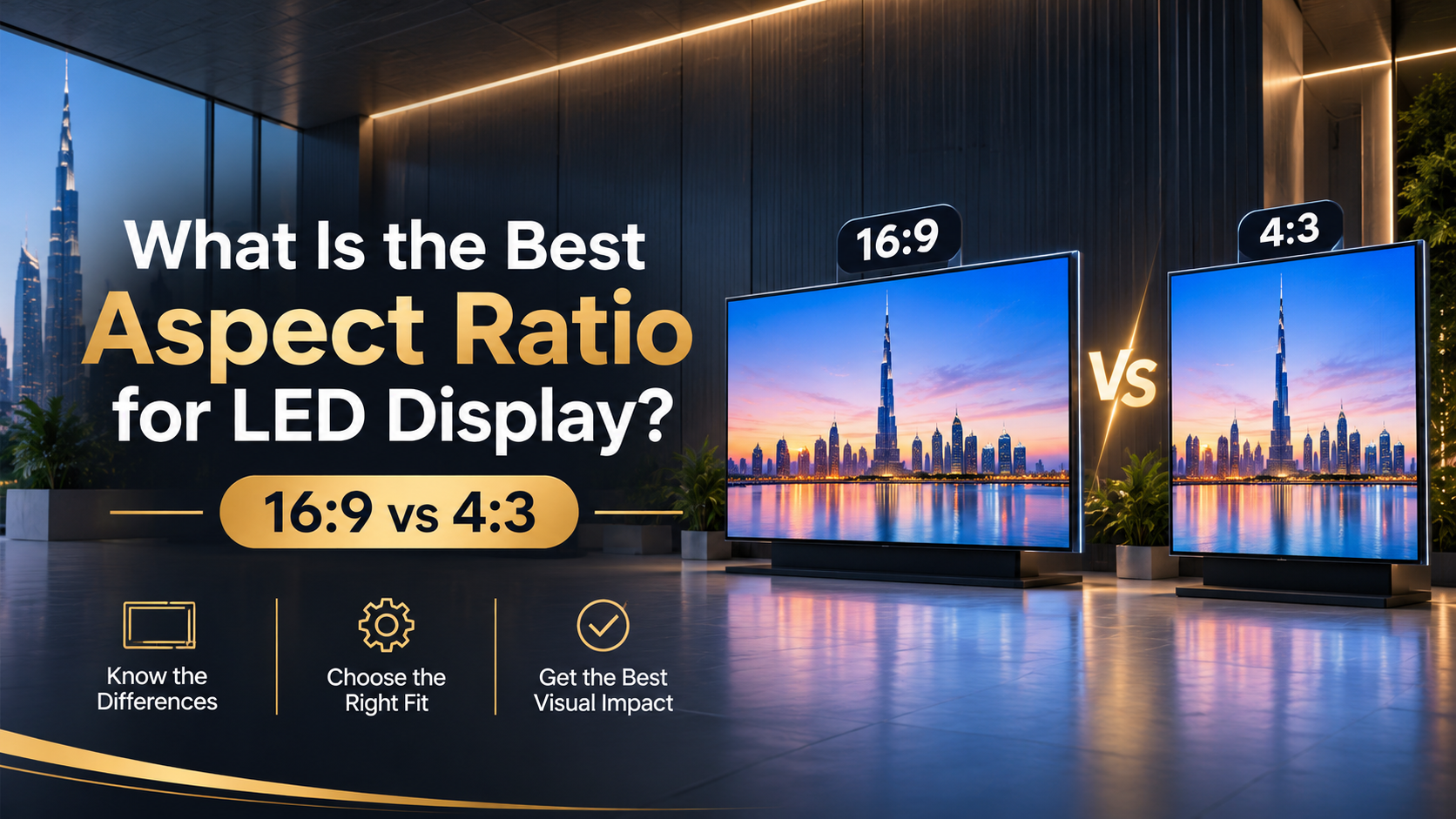
Choosing the right aspect ratio is an important consideration when purchasing an LED Display. It determines the screen’s shape and influences how videos, presentations, advertisements and other visual content appear. Two commonly used formats are 16:9 and 4:3. While 16:9 is widely preferred for modern video content, 4:3 can still be suitable for specific applications and existing display setups.
The right choice depends on several factors, including the intended application, available installation space, content format and viewing distance. Businesses planning to install an LED screen should consider these requirements before selecting a display.
What Is an Aspect Ratio in an LED Display?
An aspect ratio describes the proportional relationship between the width and height of a screen. It is expressed using two numbers separated by a colon.
For example:
- 16:9: The screen is 16 units wide for every 9 units in height.
- 4:3: The screen is 4 units wide for every 3 units in height.
The aspect ratio determines the screen’s shape rather than its actual physical dimensions. Two LED displays can have different sizes but share the same aspect ratio.
For instance, a screen measuring 3.2 metres wide and 1.8 metres high has a 16:9 aspect ratio. A smaller screen measuring 1.6 metres wide and 0.9 metres high has the same ratio.
Selecting the right aspect ratio helps content fit the display properly, reducing unwanted cropping, stretching and black bars.
16:9 vs 4:3 LED Display: What Is the Difference?
Both aspect ratios have specific applications. However, their suitability depends on the type of content being displayed and the environment in which the screen will be installed.
16:9 LED Display
The 16:9 aspect ratio is a widescreen format commonly used in modern televisions, computer monitors, online videos and presentation systems. Its wider horizontal layout makes it suitable for displaying landscape-oriented content.
Advantages of 16:9 LED displays:
- Compatible with most modern video formats.
- Suitable for advertisements and promotional videos.
- Provides a wider viewing area for presentations.
- Works well in conference rooms and auditoriums.
- Reduces the need to crop or resize standard widescreen content.
Common applications:
- Corporate meeting rooms and conference halls.
- Shopping malls and retail advertising.
- Indoor LED video walls.
- Event stages and entertainment venues.
- Digital advertising screens.
For businesses that regularly display videos, presentations and promotional content, 16:9 is often a practical choice.
4:3 LED Display
The 4:3 aspect ratio has a more traditional, almost square appearance. It was widely used in older television screens, computer monitors and presentation systems.
Although widescreen formats have become more common, 4:3 can still be useful when a display needs to accommodate older content or fit a particular installation space.
Advantages of 4:3 LED displays:
- Suitable for older presentation formats.
- Can fit installations where a wider screen is not practical.
- Works with certain legacy video and image formats.
- Offers a more compact horizontal layout for specific applications.
Common applications:
- Existing installations designed for 4:3 screens.
- Legacy presentation systems.
- Certain control rooms and specialised display environments.
- Projects with specific architectural or content requirements.
A 4:3 display may be appropriate when the content and installation layout are designed around this format.
16:9 vs 4:3 LED Display: Key Differences
Understanding the differences between these formats makes it easier to identify which one suits your requirements.
| Comparison factor | 16:9 LED Display | 4:3 LED Display |
| Screen shape | Wide rectangular | More square-shaped |
| Width-to-height ratio | 1.78:1 | 1.33:1 |
| Modern video content | Highly compatible | Requires adjustment |
| HD and 4K content | Naturally compatible | May need cropping |
| Presentations | Modern widescreen slides | Traditional slides |
| Advertising | Digital and video advertisements | Specific legacy layouts |
| Common applications | Events, retail and offices | Existing installations |
For most new installations, 16:9 offers greater compatibility with modern video and presentation formats. However, 4:3 remains an option when a project requires a traditional screen layout.
How to Choose the Right Aspect Ratio for Your LED Display
Choosing between 16:9 and 4:3 requires more than considering which format looks better. You should evaluate several factors before selecting an LED Display.
1. Consider the Type of Content
Start by identifying what you intend to display.
If your business regularly shows promotional videos, digital advertisements, live streams or widescreen presentations, 16:9 is generally a suitable option.
If you use older presentation systems or content specifically designed for a 4:3 format, a 4:3 screen may be more appropriate.
Matching the screen ratio with the source content helps avoid unnecessary cropping, stretching and black bars.
2. Evaluate the Available Installation Space
The dimensions of the installation area also influence your decision.
For example, a wide wall in a shopping mall or conference room may accommodate a 16:9 LED video wall. A restricted installation area may require a different proportion to use the available space effectively.
Before selecting a screen, measure the available width and height. Also consider structural limitations, mounting requirements, and accessibility for maintenance.
3. Consider the Viewing Distance
Viewing distance is another important factor when planning an LED display.
A screen installed in a large auditorium or outdoor advertising location may need different specifications from one used in a small meeting room.
Pixel pitch, screen resolution, and display size should be considered alongside the aspect ratio to provide suitable image clarity at the intended viewing distance.
For example, a fine-pitch LED display may be more appropriate for indoor environments where viewers sit close to the screen. Outdoor installations may require a different pixel pitch depending on the viewing distance.
4. Evaluate Your Budget and Installation Requirements
Your budget should account for more than the LED panels.
Consider the number of cabinets required, supporting structures, installation work, display processors and content requirements.
A custom-shaped LED wall may require additional planning to match the installation space and content format. Discussing these requirements with experienced LED Screen suppliers in Dubai can help you understand the available configurations and associated costs.
Does Aspect Ratio Affect LED Screen Resolution?
Aspect ratio and resolution are related, but they describe different display characteristics.
Aspect ratio determines the proportional relationship between the screen’s width and height. Resolution refers to the number of pixels used to display an image.
For example:
| Resolution | Aspect ratio |
| 1280 × 720 | 16:9 |
| 1920 × 1080 | 16:9 |
| 2560 × 1440 | 16:9 |
| 3840 × 2160 | 16:9 |
| 1024 × 768 | 4:3 |
A 16:9 LED display can support different resolutions depending on its physical dimensions and pixel pitch.
For modular LED video walls, the final resolution also depends on the number of cabinets, their individual pixel dimensions and the overall configuration.
This means you should confirm both the physical screen dimensions and native pixel resolution before finalising an installation.
Can You Customise the Aspect Ratio of an LED Display?
Yes. One advantage of modular LED displays is that they can be assembled in different configurations to suit specific installation requirements.
Unlike conventional televisions, which have fixed screen dimensions, modular LED walls use individual cabinets that can be arranged to create different screen shapes.
Some common configurations include:
- 16:9: Suitable for conference rooms, video presentations and entertainment venues.
- 4:3: Useful for legacy content and installations requiring a traditional screen shape.
- 9:16: Suitable for vertical digital signage and portrait-oriented advertisements.
- 21:9: Useful for panoramic content and wider visual presentations.
- Custom ratios: Designed for building facades, retail spaces, stage backgrounds and specialised installations.
However, the final dimensions depend on the available cabinet sizes and installation configuration. The content should also be prepared to match the display’s native pixel dimensions.
Customisation allows businesses to use LED displays in different environments without being restricted to conventional screen proportions.
Choosing the Right LED Display Aspect Ratio?
Discover the differences between 16:9 and 4:3 LED display aspect ratios and find the ideal screen format for your project. Explore our LED display solutions to create the perfect visual experience for your business.
How to Select the Right LED Screen Suppliers in Dubai
Selecting the right supplier is an important step in getting an LED display that meets your business requirements. A suitable supplier should understand the technical and practical aspects of the installation rather than simply recommend a screen based on its size.
Consider the following factors when comparing LED Screen suppliers in Dubai:
1. Product Range
Check whether the supplier offers different types of LED displays, including indoor, outdoor, rental and fixed installation solutions. A wider product range gives you more flexibility when selecting a screen for your application.
2. Technical Expertise
Look for suppliers with experience in LED display specifications, including pixel pitch, screen resolution, brightness, refresh rate and cabinet configurations.
Their technical knowledge can help you identify a suitable display for your installation environment.
3. Customisation Options
Not every project requires a standard 16:9 or 4:3 display. Ask whether the supplier can provide customised screen dimensions and configurations for different installation spaces.
4. Installation Support
Check whether installation, configuration, testing and commissioning are included in the service. Proper installation is important for the display’s performance and long-term operation.
5. After-Sales Service
LED displays may require maintenance, troubleshooting and component replacement over time. Check the availability of technical assistance and after-sales support before making a purchase.
6. Product Specifications
Request detailed product specifications before finalising your decision. Compare brightness, pixel pitch, viewing angle, refresh rate, protection ratings and power consumption based on your requirements.
Before making a decision, explain how you intend to use the screen and share the available installation dimensions. This allows suppliers to recommend a configuration that suits your content, location and viewing requirements.
Choose the Right LED Display for Your Business
Choosing between 16:9 and 4:3 depends on your content requirements, installation space and intended application. While 16:9 is a practical choice for most modern video and advertising needs, 4:3 can still suit specialised installations and traditional content formats.
If you are planning an LED screen installation, Adorn LED Screen can help you explore suitable display solutions for your project. Consider your screen dimensions, viewing distance, pixel pitch and content format before making a decision.
Explore LED display solutions from Adorn LED Screen and find an option that fits your business requirements.